
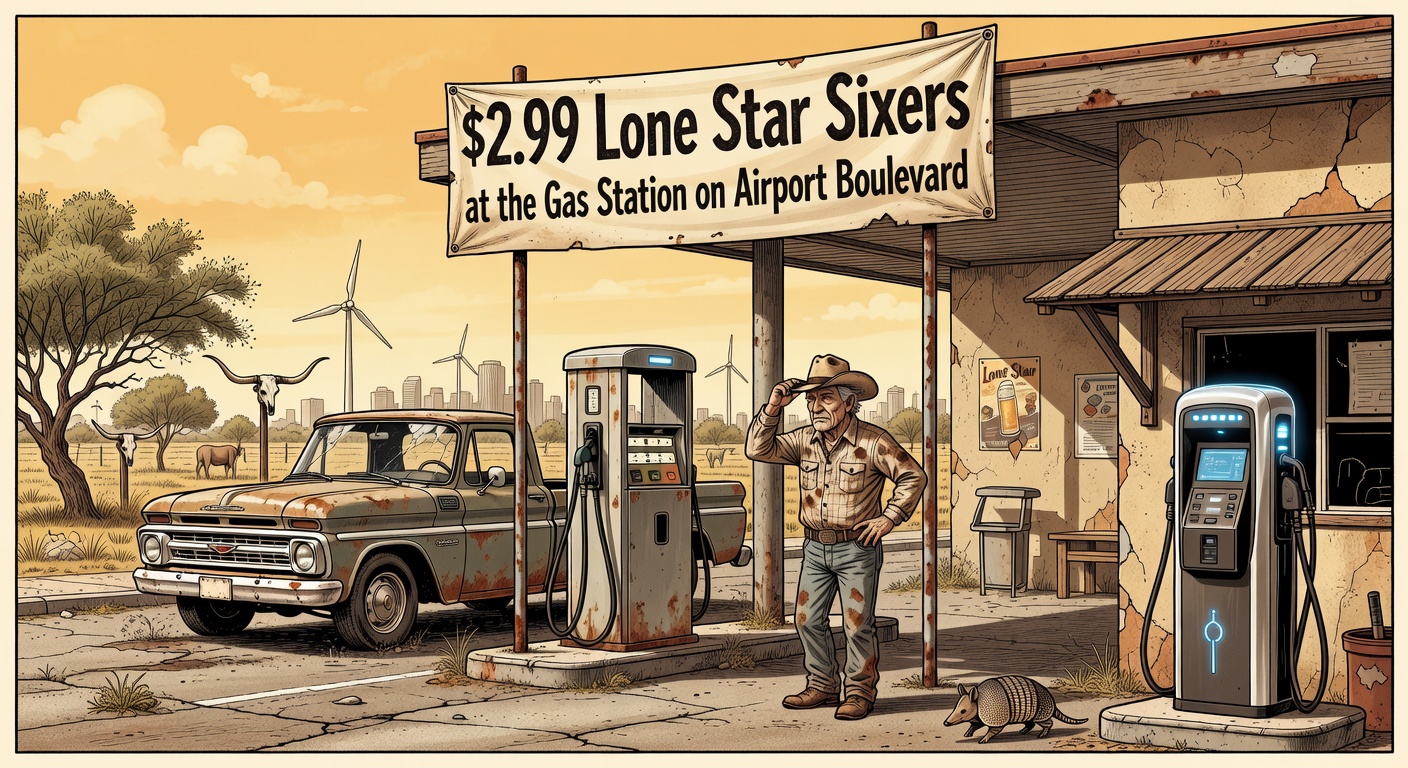
$2.99 Lone Star Sixers at the Gas Station on Airport Boulevard
The Circle K cooler at Airport and 51st used to dispense a sixer of Lone Star for $2.99 before the clerk even looked up from his crossword; last week the same transaction required an app, a loyalty scan, and left me with $19.47 on the receipt and a sudden urge to lie down in the parking lot.
The cooler door sighed the same way it always has, that heavy whoosh of refrigerated air smacking into a humid Austin evening. I stood there holding a six-pack of Lone Star tall boys like it might bite me. The digital price tag read $17.82. Not a typo. Not the fancy stuff. Just the yellow cans.
In 2003 that same cooler, same spot by the ice machine that never worked right, would have rung up $2.99. I know the number because it was gospel. You'd grab the sixer, maybe a bag of peanuts if you were feeling fancy, and still have enough from a ten to buy gas for the truck and a pack of smokes. The clerk—usually a guy named Raul who kept a tiny fan pointed at his face—would nod once, bag it without handles, and tell you to watch out for the cops on 35.
That was the entire transaction. No suggested tip. No QR code. No prompt asking if I wanted to round up for some foundation that definitely didn't exist in 2003.
I paid the $19.47 because I'd already driven across town and the alternative was whatever they're charging for a four-pack of hazy IPA at the "curated bottle shop" that replaced the video store on North Loop. The new place has Edison bulbs and a former festival coordinator explaining flavor notes while a playlist of carefully vetted "Austin originals" hums in the background. I'd rather chew glass.
The parking lot outside still has the same cracked asphalt that pools water after every thunderstorm. But the smell has changed. Used to be a perfect triangle of gasoline, frying taquitos from the roller grill, and the metallic tang of cold beer leaking from the door seals. Now it's mostly hand sanitizer, those fake "new car" tree air fresheners, and the faint ozone whiff of electric vehicle charging stations they crammed in by the air pump. The guy working the register wore a name tag that said "Hi, I'm an associate." Raul never needed a corporate greeting. He knew half the customers by the cars they drove and the other half by their orders.
You could build an entire Saturday on a $2.99 sixer. Throw two in the fridge for later, take four to a friend's backyard off Brentwood where somebody's cousin was always tuning a guitar on a porch held together by goodwill and extension cords. The beer was cold enough to hurt your teeth and cheap enough that nobody kept score about who brought what. Conversations didn't have funding rounds in them. Nobody mentioned their burn rate or cap table. The worst thing that happened was the occasional raccoon knocking over the trash can looking for leftover brisket or the neighbor yelling about the volume at 1 a.m.
These days the same amount of money gets you exactly two tall boys and a sense of mild betrayal. The rest disappears into rent for the building, which is probably owned by some LLC in Delaware that also owns three vape shops and a self-storage facility two exits up 35. The new signs scream about "supporting local" right above the Bud Light display, which is a nice touch. Local like the way a strip mall is local. Local like the way your old neighborhood suddenly has valet parking for a taco stand.
I remember the exact summer the price crept up. First to $4.29. Then $6.49. Each jump announced on a hand-written sign taped to the cooler with that blue painter's tape that left residue for years. We'd complain for five minutes, then buy it anyway because what else were you going to do—drink water? This was Austin. Beer was currency. A cold sixer bought you entry to at least three different house parties, a spot on somebody's couch, and the vague feeling that everything was going to be okay as long as the band in the garage didn't suck too bad and the cops didn't show up before the last song.
The new version of Airport Boulevard doesn't leave room for that math. Every other building is either a townhome starting at $675,000 with those slate-gray exteriors that all look like they were designed by the same depressed algorithm or one of those co-living spaces where the "community manager" throws mandatory happy hours with $9 canned wine and a QR code for feedback. The gas station hangs on like a stubborn old tooth, but you can see the developers circling with their renderings. There's already a rendering floating around on Nextdoor for something called The Hangar at Airport, which is hilarious because the only thing taking off around here is your disposable income and the property taxes.
My buddy Chuy still works construction near the old Mueller site. He told me last month he spent $42 on beer for a Friday night. Same number of people, same shitty folding chairs under the same pecan tree, different decade. "Feels like I'm buying stock in myself," he said, peeling the label off a $7.50 craft lager that tasted like it had been filtered through a pumpkin and somebody's vague memories of college in Vermont. We both laughed the way you laugh when the joke hurts in your wallet and your sense of what this town once was.
The worst part isn't even the price. It's the theater that comes with it now. The app that wants to know your birthdate so it can "responsibly" sell you beer at 9:47 p.m. The loyalty program that promises discounts after you've spent enough to buy a used Corolla from the lot on Burnet. The way the cans themselves got smaller and the prices got bigger, like some cruel magic trick performed by people who don't understand that sometimes you just want a cold beer without a TED Talk attached or a screen asking you to rate your interaction with the cooler door.
Back then the lot was a crossroads. You'd see drywall guys in paint-splattered pants, night-shift nurses from Brackenridge still in scrubs, musicians loading gear into vans with mismatched tires, and college kids who didn't yet know they were supposed to be networking. Everybody bought the same beer. Everybody paid the same three bucks. The democracy of cheap tall boys leveled the playing field in a way no civic planning committee has ever managed. Now the drywall guys shop somewhere else and the lot feels like a staging area for whatever the next corporate overlay is going to be.
I still have the ice chest from those years. It's beat to hell, lid cracked from when somebody sat on it during a particularly rowdy night in 2005, but it holds ice for days. These days it mostly sits in the garage collecting dust because filling it feels like an act of financial rebellion. A case of decent beer runs what a week's groceries did in the early 2000s. The math doesn't just fail to add up. It mocks you.
The city keeps putting up signs about preserving character while the character gets priced out block by block. Airport Boulevard used to have that ragged edge where old Austin and new money collided and mostly coexisted because the old stuff was too stubborn to leave and the new stuff hadn't yet figured out how to monetize every inch. Now the collision sounds like one side slowly getting crushed under the weight of rising totals at the register.
I walked out with my overpriced sixer and sat in the truck for a minute, engine off, watching the traffic crawl toward 183. The bag on the passenger seat looked pathetic. Six yellow cans that used to feel like freedom now felt like evidence in some long con somebody had been running on the town since the first tech bus rolled in from California.
The payphone by the air pump is long gone. Kids would actually call their parents from it after shows let out, pockets full of quarters and heads full of music that didn't need brand partnerships or sponsor-branded koozies. The video store next door with its handwritten new release signs disappeared too. In its place is another glass-fronted thing selling pour-over coffee at prices that would have covered an entire evening in 2003.
I cracked one open right there in the lot because the night was warm and the AC in my truck is older than most of the people moving into those townhomes. It tasted exactly the same as it did in 2003. Cold. Slightly metallic. Like Austin before it started charging admission to be itself and before every corner came with an algorithm deciding what was authentic.
That's the part that gets me in the ribs late at night. The beer didn't change. The people who drank it didn't fundamentally change. Somebody just changed the rules while we were busy living in the town instead of branding it. The cheap sixer was never about the beer. It was about the space it created between paychecks where you could afford to be generous with your time and your backyard and your playlist.
Progress, they call it. The signs say "Austin Unchanged" in that sans-serif font that costs extra. But the receipt in my pocket tells a different story every single time.
Some things are worth more than money. Turns out a $2.99 sixer was one of them. The real local flavor wasn't some slogan on a bumper sticker. It was the ability to hand a cold one to a stranger without first checking their credit score or verifying their startup's valuation.